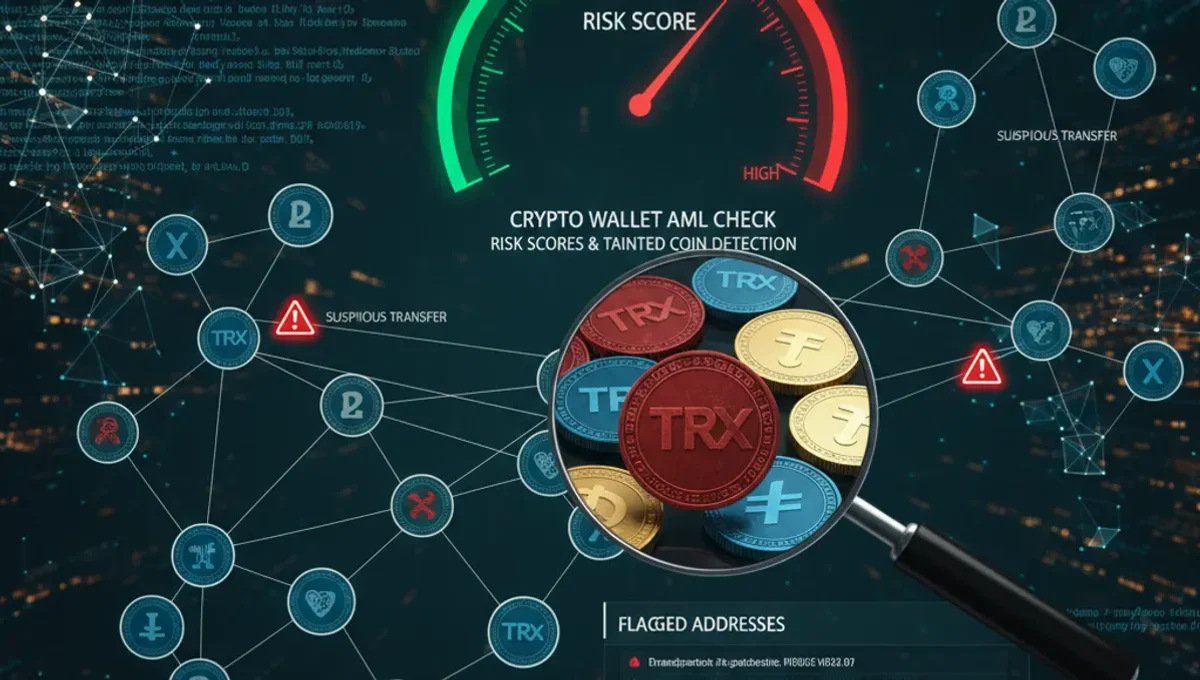
What Is a Crypto Wallet AML Check?
A crypto wallet AML check is a blockchain screening tool that traces transaction history and flags addresses linked to illicit sources. It assigns a risk score—typically low, medium, or high—based on whether the wallet has received funds from known darknet markets, theft addresses, sanctioned entities, or mixing services. The check examines the entire chain of custody: if your wallet receives USDT from an address that previously received funds from a Tornado Cash mixer or a known scam, your wallet inherits that risk. AML checks work across blockchains: TRC20 tokens on Tron, USDT on Ethereum, BTC on Bitcoin, and other major chains. The screening compares wallet activity against public sanctions lists, darknet market databases, and transaction patterns flagged by blockchain analytics firms. Unlike KYC (which verifies your identity), an AML check verifies the origin and history of the coins themselves.
How Does Crypto Wallet Screening and Risk Scoring Work?
Crypto wallet screening uses transaction graph analysis to trace funds backward through the blockchain. The system assigns risk scores by measuring proximity to illicit activity:
- Direct risk: The wallet directly received funds from a known darknet market, mixer, or theft address.
- Secondary risk: The wallet received funds from an address that received from an illicit source (one hop away).
- Tertiary risk: Multiple hops from illicit activity (older or more distant connections).
Risk scores typically range from 0–100 or are labeled low/medium/high. A score of 0–20 usually indicates clean funds with no detected illicit exposure. Scores 21–50 suggest minor risk (older transactions, distant connections). Scores 51–100 flag direct or recent exposure to mixers, darknet markets, scams, or sanctions. The scoring also considers wallet age, transaction frequency, and whether the address has interacted with known exchange wallets or legitimate services. Exchanges and custodians use these scores to decide whether to accept deposits; many freeze accounts if incoming funds score above 50–70.
Step-by-Step: How to Check a Crypto Wallet Before Receiving Funds
Follow these steps to run an AML check on a wallet address before accepting a transfer:
- Copy the wallet address you want to check (TRX, USDT, BTC, or ETH address).
- Visit a trusted AML check service—our curated AML Services list on this site includes verified providers that offer instant screening.
- Paste the address into the search field and select the blockchain (Tron, Ethereum, Bitcoin, etc.).
- Click 'Check' or 'Scan' and wait for the report (usually 5–30 seconds).
- Review the risk score and detailed findings: illicit sources, sanctions flags, mixer exposure, darknet connections.
- Check the transaction history tab to see which addresses sent funds to the target wallet and their risk levels.
- Decide: if the risk score is low (0–20) and no darknet or sanctions flags appear, the coins are likely clean. If the score is high (70+) or flags show mixer/theft exposure, decline the transfer or escalate to compliance.
For USDT and TRX specifically, also verify the token contract address matches the official USDT/TRX contract (not a fake token). Scammers sometimes send counterfeit tokens to wallets.
What Do Crypto Wallet Risk Score Levels Mean?
Risk score interpretation varies slightly by service, but the general framework is:
Low Risk (0–20): No detected exposure to darknet markets, mixers, theft, or sanctions. Funds appear to originate from legitimate sources or have clean transaction history. Safe to receive and deposit to most exchanges.
Medium Risk (21–50): Minor exposure detected—possibly old transactions from risky sources, distant connections through multiple hops, or interaction with gambling platforms. Most exchanges accept these funds but may flag the account for review. Acceptable for peer-to-peer transfers but use caution.
High Risk (51–100): Direct or recent exposure to mixers, darknet markets, scams, stolen funds, or sanctioned entities. Exchanges will likely freeze deposits or reject the transfer. Receiving these funds can trigger compliance holds and account restrictions.
Critical (90–100): Immediate darknet or sanctions exposure. Exchanges will block the account. Do not accept these funds.
Thresholds vary by exchange: some accept up to 40, others only up to 20. Check your exchange's AML policy before receiving large transfers. If you receive flagged coins by accident, contact your exchange's compliance team immediately—some exchanges can whitelist addresses or reverse holds if you provide documentation.
What Happens If Your Crypto Wallet Is Flagged as Dirty?
If your wallet receives tainted coins and is flagged during an AML check, several outcomes are possible:
Exchange deposit rejection: When you try to deposit flagged USDT or BTC to an exchange, the deposit is rejected or held in pending status. The exchange's AML system blocks the transaction if the risk score exceeds their threshold.
Account freeze: If flagged funds already entered your exchange account, the exchange may freeze your entire account pending investigation. You cannot withdraw or trade until compliance clears the hold.
Delayed withdrawal: Some exchanges place a 30–90 day hold on flagged deposits while they investigate the source. You can trade but cannot withdraw.
Account closure: Repeated receipt of high-risk funds or sanctions-flagged coins may result in permanent account closure and asset seizure (in jurisdictions with strict AML enforcement).
What to do: If your wallet is flagged, document the source of the funds (invoice, contract, peer-to-peer transaction record). Contact your exchange's compliance team with evidence that the transfer was legitimate. If the flagging was an error or the coins were sent to you without your knowledge, most exchanges will review and potentially whitelist the address. Avoid sending flagged coins to another exchange; the flag follows the coins through the blockchain.
Real Risk Categories: Mixers, Darknet, Scams, Sanctions, and Gambling
AML checks flag wallets based on exposure to these specific risk categories:
Mixers and tumblers: Services that combine multiple cryptocurrency inputs to obscure transaction trails. Receiving funds from a mixer address is a major red flag because it suggests intentional obfuscation of fund origin.
Darknet markets: Wallets linked to known dark web marketplaces (identified through law enforcement takedowns, blockchain analysis, or public research). Funds from these sources carry the highest risk.
Theft and scams: Addresses flagged as receiving stolen funds from exchange hacks, ransomware, or Ponzi schemes. These coins are often recovered by law enforcement and frozen.
Sanctions lists: Wallets belonging to individuals or entities on OFAC (US), EU, or UN sanctions lists. Receiving funds from sanctioned addresses can trigger legal liability.
Gambling platforms: Some AML services flag wallets with heavy gambling exposure (high-frequency transfers to known casino addresses). Risk level depends on jurisdiction and exchange policy.
Ransomware and extortion: Wallets that received ransom payments. These are tracked and often seized by authorities.
Most AML checks weight darknet and sanctions exposure as critical; mixer exposure as high; theft as high; gambling as medium. The recency of the exposure also matters—a wallet that received mixer funds five years ago may score lower than one that received them last month.
How to Avoid Receiving Tainted Coins and Maintain Compliance
Protect yourself by screening wallets before accepting transfers:
Before receiving USDT or TRX: Ask the sender for their wallet address and run a quick AML check through a trusted service. If the score is above your exchange's threshold (typically 50–70), politely decline or ask the sender to use a different wallet.
Set your own risk threshold: Decide in advance what risk score you will accept. For business transactions, use low (0–20). For peer-to-peer, you may accept medium (21–50), but document the reason.
Verify token contracts: Confirm the USDT contract address is the official one (not a scam token). Scammers send fake USDT to trick users.
Use reputable exchanges: Deposit to exchanges with strict AML policies—they screen inbound transfers and reduce your compliance risk.
Keep records: Save AML check reports for all large transfers. If your account is flagged later, you have proof of due diligence.
Monitor your wallet: Periodically check your own wallet's risk score. If it rises unexpectedly, investigate which incoming transfer caused the change and consider moving clean funds to a new address.
Use our AML Services directory: Start with verified AML check providers listed on this site. They offer transparent pricing, instant results, and reliable screening across TRX, USDT, BTC, and ETH.
Frequently asked questions
How long does a crypto wallet AML check take?
Most AML checks complete in 5–30 seconds. The service scans the blockchain address against known illicit sources and sanctions lists, then generates a risk score and report. Some detailed reports with full transaction history may take up to 2 minutes. Instant results are standard for reputable services.
Can I check a wallet for free?
Many AML services offer free basic checks with limited detail (risk score only). Full reports with transaction history, source analysis, and sanctions screening often require a paid subscription or per-check fee. Check our AML Services directory for providers offering free trials or freemium models.
What if I already received tainted coins?
Contact your exchange's compliance team immediately with documentation of the transfer source. If the flagging was an error or the coins were sent without your knowledge, most exchanges will review and may whitelist the address. Avoid sending flagged coins elsewhere; the risk flag follows them through the blockchain.
Does an AML check work on all blockchains?
Most AML services cover major blockchains: Bitcoin, Ethereum, Tron (TRC20), and sometimes Binance Smart Chain. Check the service's supported chains before screening. TRX and USDT addresses on Tron are widely supported by mainstream AML tools.
What risk score should I accept?
For business transactions, accept only low risk (0–20). For peer-to-peer transfers, medium risk (21–50) is often acceptable if you trust the sender. High risk (51–100) should be declined—most exchanges will freeze or reject these funds. Check your exchange's specific AML policy for their threshold.